A Comparative Analysis of Database Topic Difficulty in Relation to Web Development Readiness
Keywords:
Database, topic difficulty, diagnostic assessment, web development readinessAbstract
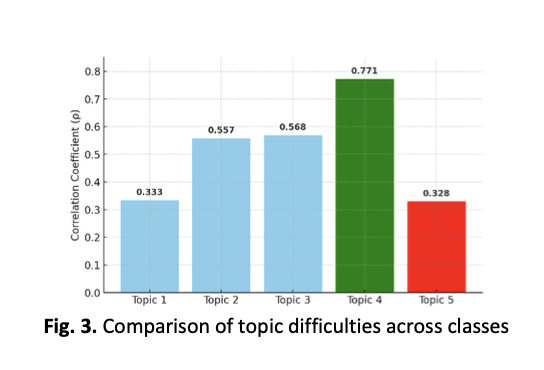
This study investigates topic-level difficulties in the Database Systems course and their implications for Web Development readiness among diploma students. A total of 129 students from four classes 2A, 2B, 2C, and 2D enrolled in the Diploma in Information Technology programme participated in this study. Final examination scores were mapped across five topics which are The Fundamentals of Database Management System, Relational Data Models, Normalisation and Entity-Relationship Diagrams (ERD), Structured Query Language (SQL), and Transaction Management. Descriptive statistics were used to identify topic-level performance, while Spearman’s rank-order correlation examined relationships between topic mastery and overall achievement. The descriptive analysis shows that Topic 1 with mean score of 0.87 and a standard deviation is 0.21, was the most understandable topic indicating that students generally had a firm grasp of foundational concepts, while Topic 2 with mean score is 0.63 and standard deviation is 0.22, was the most difficult, confirming relational modelling as a persistent area of weakness. Results further revealed that SQL demonstrated the strongest correlation with overall scores (ρ = 0.771, p < 0.001), whereas Transaction Management contributed the least (ρ = 0.328, p < 0.001). These findings underscore the importance of diagnostic assessments for identifying recurring weaknesses and guiding targeted pedagogical strategies. Strengthening competence in relational modelling and SQL at this stage is crucial, as these skills underpin effective server-side programming and database integration in the Semester 4 Web Development course.