Conceptual Framework on Social Media Addiction Culture among Baby Boomers

Authors

  • Tilagavati Subramaniam School of Communication, Faculty of Social Sciences, Quest International University, Malaysia
  • Nabillah Rafidah Abdul Kadir School of Communication, Faculty of Social Sciences, Quest International University, Malaysia
  • Zulqarnain Abu Hassan School of Communication, Faculty of Social Sciences, Quest International University, Malaysia
  • Susi Darihastining Universitas PGRI Jombang (UPJB), Jawa Timur, Indonesia

Keywords:

Technology Acceptance Model (TAM), social media addiction

Abstract

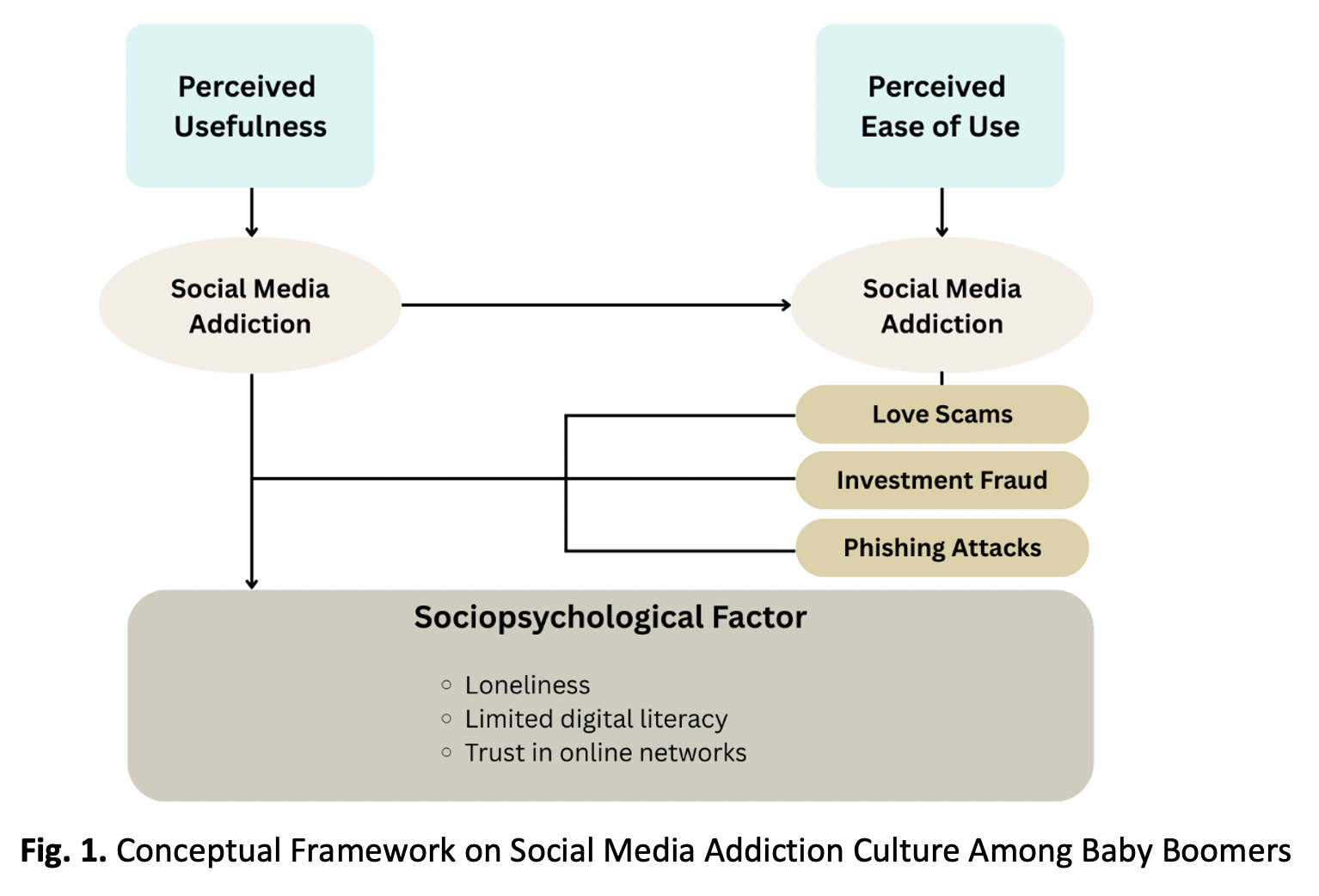
This conceptual paper examines the rising culture of social media addiction among Baby Boomers and its relationship with increasing vulnerability to online scams. While younger generations have typically been the focus of digital addiction research, recent trends reveal a significant uptick in social media usage among older adults, especially on platforms like Facebook, WhatsApp, TikTok and Instagram. Anchored in the Technology Acceptance Model (TAM), this paper proposes a conceptual framework that explains how perceived usefulness and ease of use influence Boomers’ adoption and continued engagement with social media. These drivers, while enabling digital inclusion, can also contribute to compulsive behaviour, particularly when intertwined with sociopsychological factors such as loneliness, low digital literacy, and high trust in online networks. As addiction deepens, so does susceptibility to scams, notably love scams, investment fraud, and phishing attacks issues increasingly prevalent in Malaysia. This paper employs a qualitative, theory-informed approach supported by artificial intelligence (AI) tools to strengthen rigor and transparency. A systematic search using Lit maps a scientific AI mapping tool was conducted to identify influential studies and thematic clusters. The final dataset comprised 19 articles published between 2020 and 2025. These studies were further analysed through qualitative content analysis, where manual coding supported by generative AI tools classified the literature into four themes: Baby Boomer context, social media addiction, sociopsychological factors, and effects of addiction. Insights from this human–AI synthesis informed the development of the extended TAM framework presented in this paper. Overall, the study highlights how social media culture among Malaysian Boomers has evolved beyond casual use into behaviour shaped by emotional needs and technological convenience. By integrating TAM with sociopsychological factors, this paper offers a nuanced lens for future empirical research and policy interventions aimed at strengthening digital safety for older adults.

Author Biographies

Tilagavati Subramaniam, School of Communication, Faculty of Social Sciences, Quest International University, Malaysia

tilagavati.subramaniam@qiu.edu.my

Nabillah Rafidah Abdul Kadir, School of Communication, Faculty of Social Sciences, Quest International University, Malaysia

nabillah.abdulkadir@qiu.edu.my

Zulqarnain Abu Hassan, School of Communication, Faculty of Social Sciences, Quest International University, Malaysia

zulqarnain.abuhassan@qiu.edu.my

Susi Darihastining, Universitas PGRI Jombang (UPJB), Jawa Timur, Indonesia

susipjb@gmail.com

Downloads

Published

2026-04-20

Issue

Section

Articles