Efficacy of Concept Mapping on Islamic Education Achievement Among Year 4 Students in Kuala Nerus
Keywords:
Concept mapping, Islamic education, academic achievement, Kuala Nerus, year 4Abstract
This study was conducted to evaluate the effectiveness of concept mapping compared to traditional teaching methods on the achievement of Islamic Education among Year 4 students in Kuala Nerus. The main objective of the study was to analyze the differences in students' academic achievement before and after the implementation of both methods, as well as to identify the level of student understanding. This research used mixed methods design, combining qualitative (pre- and post-form open-ended question questionnaires) and quantitative (four-point Likert scale questionnaire) approaches. The study participants consisted of 100 Year 4 students from two primary schools selected through purposive sampling. The study findings showed that the group that used the concept mapping method recorded a much more significant increase in achievement (46% increase in School A) compared to the traditional method group (16% increase in School A). The same pattern was also observed in School B (pp. 8-9). Descriptive analysis of student perceptions also showed high mean scores for the aspects of understanding (mean=3.20), memory (mean=3.29), and confidence (mean=3.12), although the aspect of seeing the relationship between concepts recorded a moderate score (mean=2.80). The study's conclusion confirmed that concept mapping is a more effective and meaningful pedagogical approach, in line with Ausubel's Meaningful Learning Theory, in systematically improving academic achievement and conceptual understanding compared to traditional methods.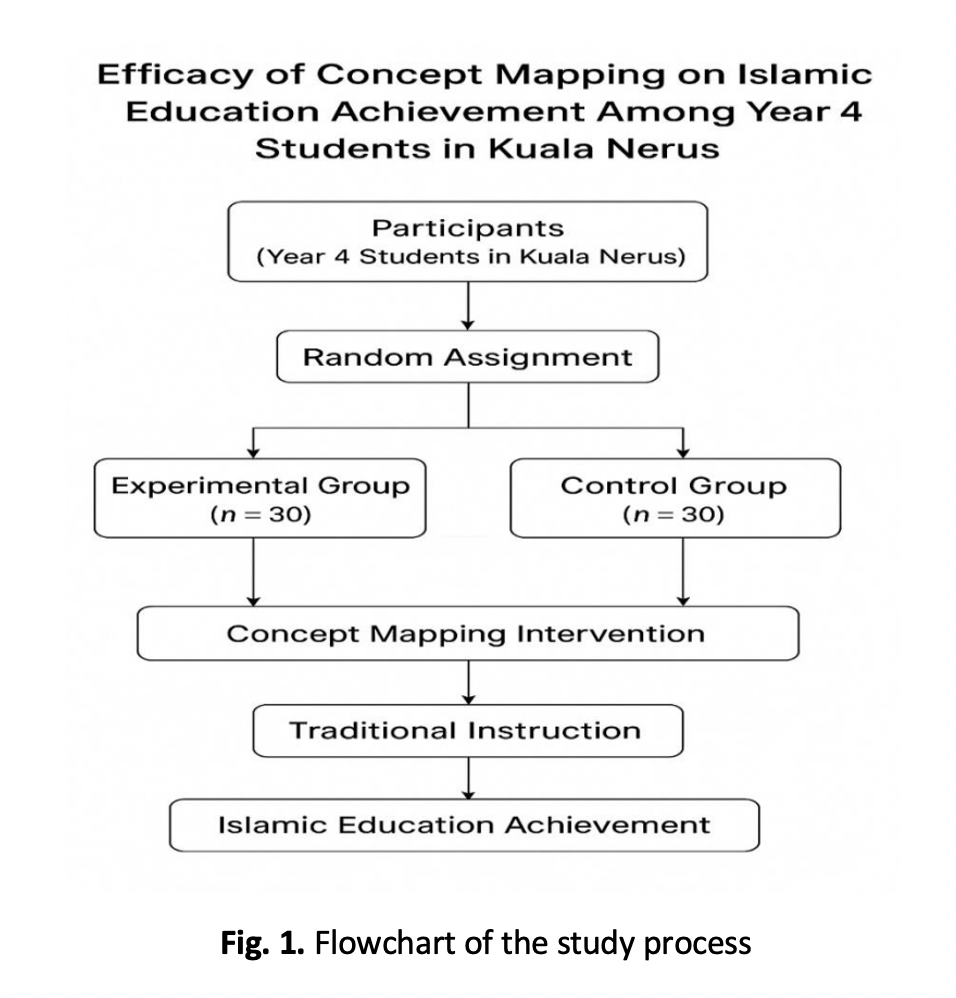
Downloads
Published
2026-03-11
How to Cite
Fauzi, M. H. Z., Wan Ismail, W. O. A. S., Sabri, M., Mustafa, M. F. H., Fauzi, A. A., Sayed Abdul Kadir, S. H. A., & Ahmad Sobri, S. (2026). Efficacy of Concept Mapping on Islamic Education Achievement Among Year 4 Students in Kuala Nerus. Pena Modern Practices in Teaching and Learning , 4(1), 1–10. Retrieved from https://penacendekia.com.my/index.php/pmptl/article/view/103
Issue
Section
Articles