Public Participation in FDI-Driven Land Governance: A Comparative Institutional Analysis for Malaysia
Keywords:
Public participation, Foreign Direct Investment, land governance, local communities, land policyAbstract
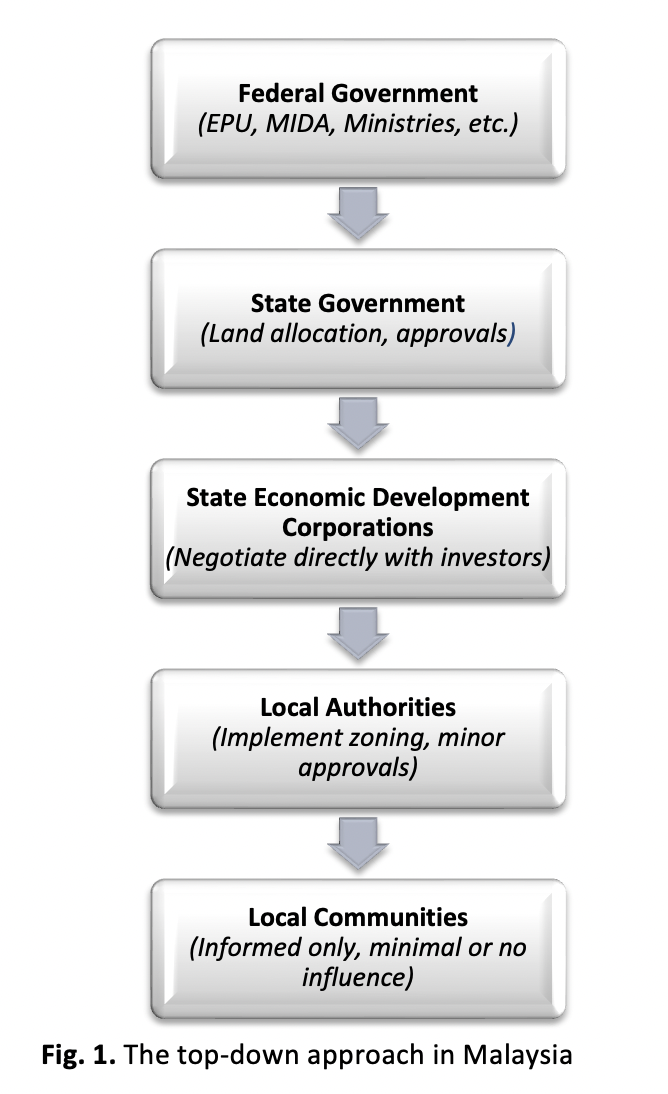
Public participation is widely recognized as a foundational principle of equitable and accountable land governance, particularly in large-scale development projects driven by Foreign Direct Investment (FDI). In Malaysia however, participatory mechanisms in FDI-related land development remain largely procedural, and weakly institutionalized, raising concerns regarding transparency, legal enforceability, and community influence over land-use decisions. This study aims to examine how public participation is structured within Malaysia’s land governance framework and to derive institutional lessons from comparative international models. The research adopts a comparative, and conceptual analytical design, integrating Ostrom’s Institutional Analysis and Development (IAD) Framework, Arnstein’s Ladder of Citizen Participation, and the World Bank’s Land Governance Assessment Framework (LGAF). Using five evaluative dimensions legal basis, institutional mechanisms, access to information, decision-making influence, and participation quality the study compares Malaysia with the Philippines, Tanzania, and Germany. The findings reveal that Malaysia’s participatory framework remains largely symbolic and concentrated at the operational level, with limited influence over substantive land allocation decisions. In contrast, the Philippines institutionalizes consent-based participation through Free, Prior and Informed Consent (FPIC), Tanzania embeds grassroots authority through decentralized village land governance, and Germany ensures procedural transparency through legally mandated early-stage consultation. The study concludes that strengthening Malaysia’s land governance requires legally enforceable participatory rights, decentralization of decision-making authority, early-stage transparency, and institutional accountability mechanisms. By integrating institutional and normative participation frameworks, this study contributes a structured comparative lens for evaluating and reforming participatory land governance in FDI-driven development contexts.